Showing posts with label Bitcoin. Show all posts

Tuesday, 28 February 2017

What and How does Bitcoin work?


WHAT IS BITCOIN

Image result for BITCOIN
Bitcoin is a cryptocurrency and a payment system  invented by an unidentified programmer, or group of programmers, under the name of Satoshi Nakamoto. Bitcoin was introduced on 31 October 2008 to a cryptography mailing list, and released as open-source software in 2009

How does Bitcoin work?

Image result for BITCOIN
This is a question that often causes confusion. Here's a quick explanation!

The basics for a new user

As a new user, you can get started with Bitcoin without understanding the technical details. Once you have installed a Bitcoin wallet on your computer or mobile phone, it will generate your first Bitcoin address and you can create more whenever you need one. You can disclose your addresses to your friends so that they can pay you or vice versa. In fact, this is pretty similar to how email works, except that Bitcoin addresses should only be used once.

Bitcoin

Balances - block chain

The block chain is a shared public ledger on which the entire Bitcoin network relies. All confirmed transactions are included in the block chain. This way, Bitcoin wallets can calculate their spendable balance and new transactions can be verified to be spending bitcoins that are actually owned by the spender. The integrity and the chronological order of the block chain are enforced with cryptography.

Transactions - private keys

A transaction is a transfer of value between Bitcoin wallets that gets included in the block chain. Bitcoin wallets keep a secret piece of data called a private key or seed, which is used to sign transactions, providing a mathematical proof that they have come from the owner of the wallet. The signature also prevents the transaction from being altered by anybody once it has been issued. All transactions are broadcast between users and usually begin to be confirmed by the network in the following 10 minutes, through a process called mining.

Processing - mining

Image result for bitcoin Processing - mining
Mining is a distributed consensus system that is used to confirm waiting transactions by including them in the block chain. It enforces a chronological order in the block chain, protects the neutrality of the network, and allows different computers to agree on the state of the system. To be confirmed, transactions must be packed in a block that fits very strict cryptographic rules that will be verified by the network. These rules prevent previous blocks from being modified because doing so would invalidate all following blocks. Mining also creates the equivalent of a competitive lottery that prevents any individual from easily adding new blocks consecutively in the block chain. This way, no individuals can control what is included in the block chain or replace parts of the block chain to roll back their own spends.

Going down the rabbit hole

This is only a very short and concise summary of the system. If you want to get into the details, you can read the original paper that describes the system's design, read the developer documentation, and explore the Bitcoin wiki.

Capital Controls and Ponzi Schemes: How Nigeria Is Discovering Bitcoin

Capital Controls and Ponzi Schemes: How Nigeria Is Discovering Bitcoin

Image result for Capital Controls and Ponzi Schemes: How Nigeria Is Discovering Bitcoin


The price collapse of “black gold” locked Nigerians into their economy. Now, “digital gold” is providing some Nigerians with a way out.
Only three years ago, crude oil cost over $100 a barrel. But that peak came tumbling down. Throughout 2014 and 2015, oil prices took an almost unprecedented plunge to the $30 range, and is currently trading around $50 a barrel. As the lifeblood of Africa’s largest economy, Nigerian income from exports plunged with it.
Faced with dwindling foreign currency reserves, Nigeria’s central bank was quick to impose capital controls. Whole industries were banned from importing goods; the Nigerian president wanted businesses to buy their products from domestic suppliers. Instead, this policy led to widespread shortages of raw materials, machine parts and supermarket products. Additionally, foreign currency–denominated Nigerian bank cards had strict spending limits imposed, preventing Nigerians from shopping abroad or paying overseas school fees.

Nigeria initially refused to devalue its currency, the naira (NGN), which was pegged to the U.S. dollar. However, that led to black market rates for U.S. dollars, increasing to levels almost double that of the official figures. As of June 2016, the naira exchange rate was finally allowed to float. As a result, the national currency fell by about 40 over the last year, according to official figures.
Perhaps unsurprisingly, Bitcoin is gaining ground.
Tim Akinbo is a 35-year-old software developer and Bitcoin enthusiast from Nigeria, and the only person in West Africa running a full node.
“There’s been quite some interest in bitcoin use in Nigeria recently,” he told Bitcoin Magazine. “It’s definitely growing. The devaluation of the national currency is an obvious reason, as bitcoin serves as a hedge in that respect. But companies have also started to use bitcoin for imports. Either through companies like BitPesa, or individually. And Nigerians in the diaspora also increasingly use bitcoin to send money to their family and friends at home.”
This observation is perhaps best reflected in the increase in Nigerian trading volume on LocalBitcoins.com. This has regularly topped 400 million NGN ($1.2 million) per week, more than the entire eurozone combined. Moreover, the bitcoin exchange rate even reached some 500,000 NGN ($1,600) on Nigerian exchanges recently; similar premiums were previously seen in other countries faced with capital controls or monetary woes, like China and India.
Other figures show similar trends. Of all countries, Nigeria tops theGoogle trend charts for most “Bitcoin” searches. Asked by Bitcoin Magazine, several wallet providers — including Mycelium, Bitcoin Wallet, Breadwallet and BTC.com — reported significant relative growth in downloads from the African country: new installs in some cases increased around 2000% since October. And as another indicator of success, Africa-focused Bitcoin startup BitPesa secured a $2.5 million funding round from leading venture capital firms onlylast week.
Alejandro De La Torre is the business development manager for Bitcoin wallet provider BTC.com, and speaking to Bitcoin Magazine he confirmed this sentiment.
Image result for Capital Controls and Ponzi Schemes: How Nigeria Is Discovering Bitcoin
“Wallet downloads from Nigeria were only topped by the United States and India. For a developing country that’s not known to be very tech savvy, with relative high illiteracy, and that has less inhabitants than countries like China, Indonesia or Brazil, that had us very surprised,” De La Torre told Bitcoin Magazine. “We’re now in the process of setting up a meetup in Lagos, which already has 130 members signed up in three weeks. I think Bitcoin interest in Nigeria is growing exponentially.”
https://akinbo.org/

Monday, 27 February 2017

Police Can Now Catch Criminals Who Used Bitcoin

Danish Police Can Now Catch Criminals Who Used Bitcoin

Image result for Danish Police Can Now Catch Criminals Who Used Bitcoin
Bitcoin was never really anonymous, and it seems the Danish police have caught on to that fact. According to reports by Danish newspaper Berlingske, law enforcement in the Scandinavian country has figured out how to apply blockchain analysis to hunt down and prosecute darknet market vendors. 
Blockchain Analysis
Bitcoin has been presented as an anonymous digital currency for a long time. But this is not really accurate. While payments are not made to real-world identities, they are made to Bitcoin addresses that are publicly available on the blockchain. If such an address can be tied to a real-world identity, all anonymity is lost. That’s why some refer to Bitcoin as “pseudonymous” rather than anonymous.
By applying blockchain analysis and combining this with Know Your Customer (KYC) and Anti-Money Laundering (AML) policies by bitcoin exchanges, Danish police are able to track down darknet market users.
“We are pretty much unique in the world at this point because no one else has managed to use these tracks as evidence,” Aarenstrup told Berlingske. “Everyone is looking toward Denmark in this field, and we are in close dialogue with a number of other countries right now so we can further develop methods and teach them how we do it here.”
More specifically, it seems the Danish police are using blockchain analysis to close a sort of legal loophole utilized by users of darknet markets like AlphaBay and Silk Road. Contraband — often illegal drugs — are typically shipped to the home addresses of darknet customers. But if the package is intercepted by the police, the buyer can simply deny having ordered anything.
Cybercrime
Image result for Danish Police Can Now Catch Criminals Who Used Bitcoin
In part due to its perceived anonymity, Bitcoin has grown to be a wildly popular payment method for cybercriminals. In a report published last year, Europol - the law enforcement agency of the European Union - said more than 40 percent of online transactions for illegal ends are made with bitcoin.
Speaking to Berlingske, Aarenstrup acknowledged that the ease of use of bitcoin is a growing concern:
"Bitcoin - and virtual currency in general - is widely used in the trafficking of weapons and drugs, and in ransomware and extortion cases. It is used a lot by criminals."
Unsurprisingly, Bitcoin is increasingly becoming a central point of focus for cybercrime units worldwide. Only last month, a joint initiative of Europol, Interpol (the intergovernmental organization facilitating international police cooperation) and the Basel Institute on Governance (an independent not-for-profit competence center specializing in financial crime) indicated that they would up the efforts to counter bitcoin money laundering.
And Danish authorities have been paying attention to the digital currency for some time now as well. A 2015 strategic analysis report by the Danish National Police mentioned bitcoin as a key focal point to counter cybercrime.
The success of the new Danish tracking method appears to have already been embraced by international organizations: both the FBI and Europol are already using the system, according to Berlingske.
"I would just say to those out there in the criminal community that they need to be careful because we can follow them. They should not think they can hide from the police anymore," Aarenstrup concluded.

Friday, 17 February 2017

Ledger Blue; An enterprise grade security device

Ledger Blue

An enterprise grade security device


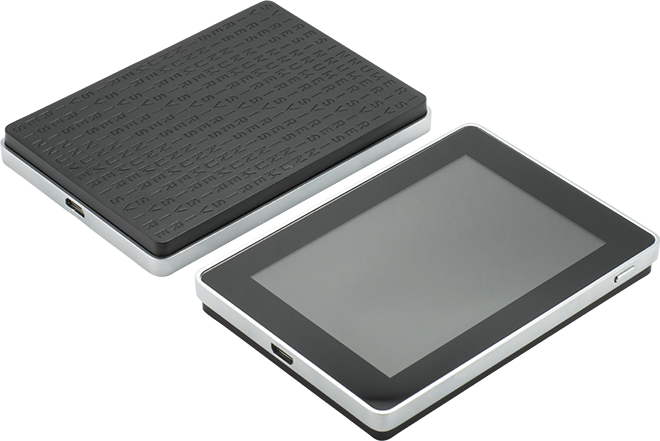
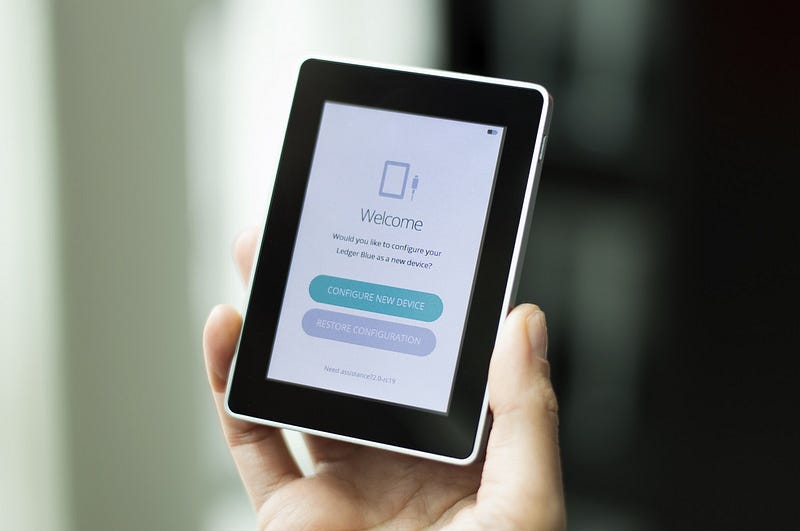
Ledger Blue is the most advanced hardware security gear on the market. It boasts multi application execution, and packs enterprise-level crypto-capabilities into a lightweight handheld device designed and crafted in France. It is architected around a Secure Element, featuring a touchscreen and USB & Bluetooth connectivity.
It is available for the price of 229 EUR (without VAT).


A powerful and flexible device

Blue is the latest generation product from Ledger, the result of more than two years of research and development. This high-end device embeds a large touchscreen to securely manage transactions and complex smart contracts. Its slick yet robust casing encloses the best-in-class technology built upon Blockchain Open Ledger Operating System (BOLOS), a powerful and flexible platform.


Packed with hardware features

The Ledger Blue is based on a dual-chip architecture embedding a ST31 Secure Element and a STM32 microcontroller thus achieving a fully isolated environment. It features a LED-backlit color touchscreen to navigate easily and validate transactions. It is powered by a lipo rechargeable battery and communicates with USB or Bluetooth devices.


Designed for multiple secure apps

Thanks to its modular architecture, the Ledger Blue runs multiple dedicated companion apps in full isolation on top of its firmware. The strong security model allows to add new cryptocurrencies or apps without the risk of compromission of the master seed. Transaction integrity is ensured by the WYSIWYS paradigm (What You See Is What You Sign). The flexibility of the device enables enterprise level usage: with all major crypto libraries embedded in the firmware, any type of blockchain can be supported.


What our technological partners say about the Ledger Blue


Stratumn introduced the concept of “Proof of Process”: a scalable protocol that allows multiple partners to trust a common process, or a workflow, by decoupling the proof of data from the secret data in a way that results in a single contextual proof that spans all the steps of a process.
“At Stratumn, we closely partner with Ledger to secure how customers and partners interact with Proof of Process Technology. Their open source SDK allows our team to build application-specific interfaces, making the experience seamless and complete.” — Richard Caetano, CEO Stratumn


Monax Industries (formely Eris Industries) empowers developers to embrace participatory software architecture via distributed computing and smart contract systems. Monax’s products comprise the first platform that allows the full potential of blockchain based technologies to be realized in enterprise. Monax announced a partnership with Ledger regarding hardware security in 2016.
“When deploying enterprise blockchain applications in production, security of digital assets and cryptographic keys is of paramount importance. The Ledger Blue is a powerful and flexible solution for enterprise grade blockchain applications, ensuring integrity of transactions at the endpoint level.” — Casey Kuhlman, CEO Monax


STMicroelectronics is a world leader in providing semiconductor solutions with one of the industry’s broadest product portfolios, notably in hardware security. Ledger announced its collaboration with STM in March 2015 for the design of the Ledger Blue.
“STMicroelectronics’ microcontroller and radio technologies offer a broad range of advanced features including hardware security, reliable connectivity, and low power consumption, allowing Ledger and other partners to create unique and innovative devices that combine banking-grade security with full system openness” — Marie-France Florentin, General Manager, Secure Microcontroller Division, STMicroelectronics


Main features

  • Cryptographic secrets protected by an EAL6+ Secure Element (ST31G480)
  • 3"5 inches color touch screen interface
  • BLE 4.1, USB 2.0 FS, NFC (will require firmware update)
  • 500mA lipo rechargeable battery
  • What You See Is What You Sign (WYSIWYS) security paradigm
  • 4–8 digits PIN security lock for identity attestation
  • passphrase support
  • alternate PIN for plausible deniability
  • Built-in onboarding and configuration (seed generation and recovery)
  • BIP39 seed standard (12/18/24 words), compatible with all Ledger products
  • Certified FIDO U2F (second factor authentication for Google, Github, Dropbox, Dashlane and many others)
  • Multi-apps quick launch dashboard
  • Ledger Manager: install & remove apps, firmware upgrades
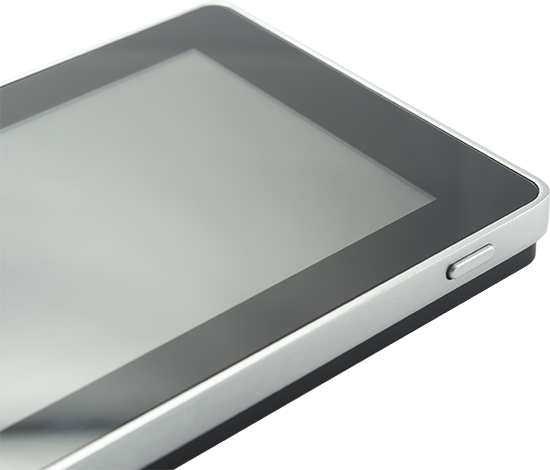
  • Strong and durable casing, anti scratch glass
  • Enterprise app licensing & support available
Ledger Blue is built upon the BOLOS platform, a powerful and flexible Operating System allowing secure execution of multiple Open Source applications in full isolation. Developers can leverage the SDK to deploy custom applications and use the Blue as a trust device for any kind of use case.

Blockchain support

  • Bitcoin (COLU, Counterparty support)
  • Ethereum (ETH/ETC), tokens & contracts support
  • All bitcoin clones: Litecoin, Dogecoin, Zcash…
  • Monero*
  • Tendermint*
  • Hyperledger*
  • Sidechains (Liquid)*
* in development

Software support

  • Ledger Wallet Bitcoin Chrome app (Bitcoin, Litecoin, Dogecoin, Zcash, Dash)
  • Ledger Wallet Ethereum Chrome app (ETH/ETC)
  • MyEtherWallet.com (Chrome, Opera, Firefox with U2F extension)
  • GreenBits & GreenAddress
  • Copay (Chrome app)
  • Electrum
  • Mycelium

Cryptographic support


  • Message Digest: RIPEMD160, SHA224, SHA256, SHA384, SHA512, SHA3, SHA3-XOF, KECCAK
  • Cryptography Key, with key generation: DES (64, 128,192 bits), AES (128 bits), ECC (256 bits), RSA (1024, 2048, 3072,4096 bits)
  • RSA encryption with PKCS1 v1.5, PKCS1 OEAP, NOPAD schemes
  • HMAC Signature: HMAC-SHA256, HMAC-SHA512
  • RSA Signature with PKCS1 v1.5, PKCS1 PSS schemes
  • Elliptic Curve Signature: ECDSA/EC-Schnorr (SECP256K1, SECP256R1, Brainpool256R1, Brainpool256T1), EdDSA (Ed25519)
  • Elliptic Curve Diffie Hellman: ECDH (SECP256K1, SECP256R1, Brainpool256R1, Brainpool256T1, Curve25519)
  • Symmetric Cryptography: DES, Triple-DES, AES with ISO9797M1, ISO9797M2, NOPAD schemes
  • Random Number Generation: RND, Prime RND (hardware support TRNG)

Ledger Nano S

Ledger Nano S: secure multi-currency hardware wallet

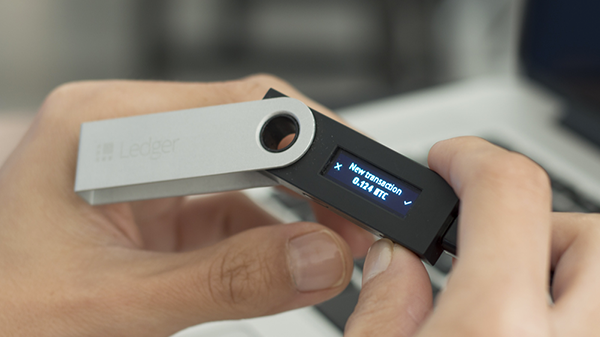
Ledger Nano S is a secure Bitcoin and Ethereum hardware wallet. It connects to any computer through USB and embeds a built-in OLED display to double-check and confirm each transaction with a single tap on its side buttons.


It is available for the price of 58 EUR (+VAT) and is fully compatible with the previous generation of Ledger products if you want to import an existing account.

Main features

  • Cryptographic secrets protected by a secure chip
  • Bitcoin and Ethereum support (Open Source apps)
  • Confirmation of transactions on the embedded screen
  • Built-in 4 digit PIN security lock
  • Built-in onboarding (seed generation and recovery)
  • BIP39 seed (12/18/24 words), easy backup and restoration
  • Multi-apps support: FIDO U2F, GPG, SSH…
  • USB connectivity
  • Foldable and compact casing
  • Compatible with Ledger Wallet Bitcoin Chrome application and Ledger Wallet Ethereum Chrome application

Features with Firmware 1.2

To unlock these features, it is necessary to install the firmware 1.2.
  • Passphrase support for plausible deniability or seed backup protection (compatible with BIP39)
  • Alternative duress PIN
  • Shuffle PIN option
  • Token & basic contract support (data field) for Ethereum
  • MyEtherWallet integration on Chrome and Opera without third party extensions
  • Support for GreenAddress & Greenbits (Android, desktop coming soon)
  • Litecoin support
  • Ledger Manager: application & firmware updates
Nano S is architectured around the BOLOS platform, a powerful and flexible Operating System allowing the secure execution of multiple Open Source applications in full isolation.


Why the need for a hardware wallet?


Secure 2FA validation of a transaction directly on the device

If you are not familiar with the notion of hardware wallets, you may wonder what the advantages are versus a paper wallet or an encrypted private key on a computer.
The main principle behind hardware wallets is to provide full isolation between the cryptographic secrets (private keys) and your easy to hack computer or smartphone. Vulnerabilities of modern PCs and smartphones are well known, and if you keep your private keys there (private key = your bitcoins) it’s just a matter of time before you’ll get hacked and lose everything.
A paper wallet may be secure, but only until you want to use your funds, requiring importing your private keys on your computer. And if you think a password encrypting your keys is enough, a malware is smart enough to wait for the inevitable decryption before sweeping your funds.
Hardware wallets are convenient, affordable, portable and backed up by a paper wallet allowing easy recovery in case of loss. If you have any significant amount of bitcoins, using a hardware wallet should be a no brainer.

Ledger Wallet Chrome applications for Bitcoin and Ethereum

Ledger Wallet Chrome applications

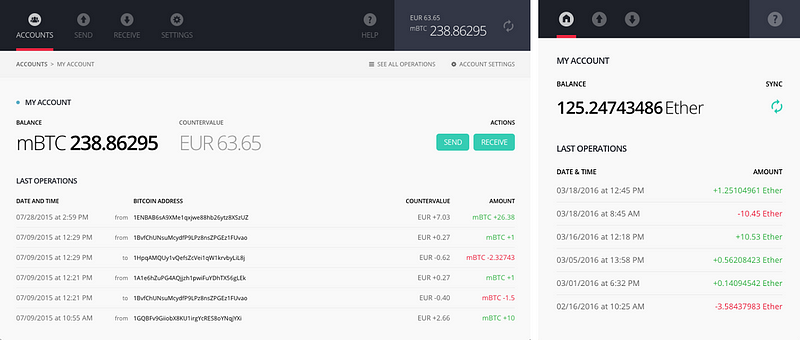
Nano S comes with a set of Chrome applications to manage your cryptocurrency wallets. The Bitcoin Chrome app is an award winning wallet featuring multi-accounts and rich settings.
In order to manage ethers (the cryptocurrency from the Ethereum network), we have launched a dedicated Chrome app, functioning on the same principles as the Bitcoin one. You can have different accounts and securely receive or send ETH/ETC from your Nano S.
The Ledger Manager is a tool to update your firmware and install new applications on your Nano S.

FIDO U2F authenticator


Nano S is running a certified U2F app and can be used as a second factor security key for Google, Github, Dropbox and other compatible services.
This 2FA mechanism replaces SMS or OTP codes such as Google Authenticators or Authy, and is not only much more secure but also really practical to use.

Open Source

All apps running on Nano S are Open Source. You can audit, review or contribute to the code. Here is the full list of available Nano S and Chrome apps:
Nano S embedded apps
Chrome applications


Nano S for developers

If you are a developer, you can build your own apps for Nano S. Our Ledger Blue SDK is fully compatible with Nano S (UI mechanisms aside) and you can leverage our development tools to start experimenting.