Pages
  • Home
  • About
  • WRITE FOR US
  • Privacy Policy
  • Contact us
TECH TUMO

All About TECH, CODE,ROBOT, IOT AND FUN. This site is all about latest technology trends, news, smartphones and geeky 'how to do things' tutorials and internet of things.

Category
  • Home
  • Gadgets
    • Computing
    • Entertainment
    • Health
  • Internet
    • IOT
    • News
  • REVIEW
  • HOW TO
Showing posts with label TECH. Show all posts

Thursday, 2 March 2017

HIS HD 6870 IceQ X

TECH  

HIS 6870 IceQ X Turbo X Review

Radeon HD 6870 HIS ICeQ X Turbo X
With the same high-performing cooler, the HIS 6870 IceQ X Turbo X should be remarkably similar to the HIS 6950 IceQ X Turbo X reviewed previously. The mid-range 6870 should run cool and quiet while sporting hefty overclocks like the high-end cards. Lets see if that holds true as we torture the HIS 6870 with some intense overclocking and benchmarks.

Image result for HIS HD 6870 IceQ X

Product Specifications and Features

The 6870 has been released for quite some time now, so it is not necessary to explain the the technical details and features. You can see that HIS 6870 IceQ X Turbo X sports very aggressive factory overclocks on  coming in at a blazing 975Mhz core with the memory at 1150Mhz out of the box. That is impressive from the reference clocks of 900Mhz/1050Mhz.

Technical Features

The 6870 comes with similar features as its bigger brothers do. Below is a list from the HIS website of the major features of this card.

Cooling

Image result for HIS HD 6870 IceQ X

In order to fulfill its promises of a -15° C cooler temperatures and 15db quieter operation, HIS has placed the latest IceQ cooler on the 6870. The heatsink has a nice ice blue cover helping route the airflow and give it that ‘IceQ’ look. The newest version of this cooler uses four aluminum heat pipes along with aluminum fins and a 92mm fan blowing down on to the heatsink. Air flow then exhausts partially out the back of a case, through the top and rear. Below you can see a picture of the cooling system broken down in to its parts showing how it works:

With this cooler and the automatic fan profile, the card never broke 60° C with a 23° C ambient. The fan ramped up to around the 65% mark, so it fairly quiet throughout the benchmarking and gaming sessions. Definitely audible, but quiet. When I cranked up the fan to 100% and tested that way, the card never broke 55° C even when overclocked with added voltage. Pretty impressive feat.
Overall this is one of the quietest and most effective coolers on a GPU I have seen in a while, especially when compared to the reference coolers. The auto profile in Afterburner kept the card cool and quiet throughout its active life with me which was nice to finally not have to adjust it manually.  HIS has a great cooler for the IceQ series of cards… effective, and quiet.
Image result for HIS HD 6870 IceQ X


As you can see we achieved some decent results when overclocking this card to the max. It wasn’t as big of an increase as the other cards in this series, however this card started out at 975Mhz in the first place. I was able to achieve 1021Mhz core and 1200Mhz memory to pass most tests with the voltage set on the Afterburner maximum of 1.3v. On Vantage I had to drop the core back to 1000Mhz.  I kept the fan cranked at 100% for these tests and the card peaked around 55° C. Not much of a difference vs stock speeds! I was a bit disappointed in the lack of headroom for overclocking, but after researching a bit hwbot.org, it seems as though the clocks I achieved are about normal and my expectations were just out of line. It just goes to show how aggressive the factory overclocks are on this card.

Nokia 5 is official with beautiful aluminium unibody And 5.2” HD display

TECH  


Nokia 5 is official with beautiful aluminium unibody, 5.2” HD display and Pure Android experience

Image result for Nokia 5
At the Mobile World Congress 2017, Nokia brand licensee partner, HMD Global launched Nokia 5. The Nokia 5 is the next Android smartphone after Nokia 6 went exclusive in China, last month. Nokia 5 comes with sophisticated design with precision-milled aluminium unibody offering excellent durability and quality.

About Nokia

Nokia used to be one of the world’s biggest mobile phone manufacturers but it fell behind with the advent of iPhone and Android smartphones. In 2014, Nokia’s Devices and Services division was sold to Microsoft. In 2016, Finnish company HMD Global bought a part of Microsoft’s feature phone business and has a licensing agreement that allows it to make smartphones under the Nokia brand.


HMD also talked about throwing pure Android experience on its devices with Android Nougat, promising regular Google security updates for years to come. An experience that’s focused and clutter-free, while make sure to stay on top of features and security.
Nokia 5 smartphone was launched in February 2017. The phone comes with a 5.20-inch touchscreen display with a resolution of 720 pixels by 1280 pixels.

The Nokia 5 is powered by octa-core Qualcomm Snapdragon 430 processor and it comes with 2GB of RAM. The phone packs 16GB of internal storage that can be expanded up to 128GB via a microSD card. As far as the cameras are concerned, the Nokia 5 packs a 13-megapixel primary camera on the rear and a 8-megapixel front shooter for selfies.

The Nokia 5 runs Android 7.1.1 and is powered by a 3000mAh non removable battery. It measures 149.70 x 72.50 x 8.05 (height x width x thickness) .

The Nokia 5 is a dual SIM (GSM and GSM) smartphone that accepts Nano-SIM and Nano-SIM. Connectivity options include Wi-Fi, GPS, Bluetooth, USB OTG, 3G and 4G (with support for Band 40 used by some LTE networks in India). Sensors on the phone include Compass Magnetometer, Proximity sensor, Accelerometer, Ambient light sensor and Gyroscope.

Full phone specifications:

Display
Size and type: 5.2” IPS LCD
Resolution: HD (1280 x 720, 16:9)
Material: 2.5D sculpted Corning® Gorilla® Glass display
Brightness: 500 nits, laminated
Features: Sunlight visibility improvement, polarizer
Performance
Operating system: Android™ 7.1.1 Nougat
RAM: 2 GB
CPU: Qualcomm® Snapdragon™ 430 mobile platform
Battery type: Integrated 3000 mAh battery
 Storage
Internal memory: 16 GB
MicroSD card slot: Support for up to 128 GB
Services: Google Drive
 Camera
Primary camera: 13MP PDAF, 1.12um, f/2, dual tone flash
Front-facing camera: 8MP AF, 1.12um, f/2, FOV 84 degrees
Network and connectivity
Network speed: LTE Cat. 4, 150Mbps DL/50Mbps UL
Networks GSM: 850/900/1800/1900; WCDMA: Band 1, 2, 5, 8; LTE: Band 1, 3, 5, 7, 8, 20, 28, 38, 40
Audio
Connector: 3.5 mm headphone jack
Speakers: Single speaker
Amplifier: Smart amplifier (TFA9891)
Connectivity and sensors
Connectivity: Micro USB (USB 2.0), USB OTG, Wi-Fi, Bluetooth 4.1
Sensors: Accelerometer (G-sensor), ambient light sensor, e-compass, fingerprint sensor, Hall sensor, gyroscope, proximity sensor, NFC
Design
Colors: Tempered Blue, Silver, Matte Black, Copper
Size: 149.7 x 72.5 x 8.05 mm (8.55 with camera bump)
In the box
Your Nokia 5
Charger
Charging/data cable
Headset
Quick guide
SIM door key

Nokia 3310 Dual SIM

TECH  


Nokia 3310 Dual SIM:  The icon is back


Nokia-3310-Hero.pngA modern classic reimagined.
  • Battery standby for up to a month
  • Four colors to choose from
  • Play the classic Snake

THE DESIGN

Iconic rounded form, updated

The new Nokia 3310 takes the iconic silhouette of the original and reimagines it for 2017. The custom designed user interface brings a fresh look to a classic, whilst the 2.4” polarized and curved screen window makes for better readability in sunlight.

BATTERY FOR DAYS

Boundless battery

Remember when you could leave the house without a charger? Well, with the new Nokia 3310, you can. It comes with a long-lasting battery, so you can talk all day, or leave the phone on standby for up to a month. When needed, a Micro-USB port makes charging simple.
3310-DesignBlock.png

INHERENT COLOR

Four great shades to choose from

Nokia 3310 is made to fit your style. It comes in four distinct colors: Warm Red and Yellow, both with a gloss finish, and Dark Blue and Grey both with a matte finish. What’s best, the color runs through the material, so it looks better for longer.

Full specifications

IN THE BOX
DESIGN
NETWORK AND CONNECTIVITY
PERFORMANCE
STORAGE
AUDIO
DISPLAY
CAMERA
CONNECTIVITY
BATTERY LIFE

Your Nokia 3310
Nokia MicroUSB charger
WH-108 headset*
Quick guide
*Varies by market, please check availability

Colors Warm Red (Glossy), Dark Blue (Matte), Yellow (Glossy), Grey (Matte)
Size 115.6 x 51 x 12.8 mm

Network speed 2G
Networks GSM 900/1800 MHz

Operating system Nokia Series 30+

Internal memory 16 MB4
MicroSD card slot Support for up to 32 GB, memory card sold separately

Connector 3.5 mm AV connector
Apps FM radio, MP3 player

Size and type 2.4” QVGA

Primary camera 2MP
Flash LED flash

Connectivity Micro USB (USB 2.0), Bluetooth 3.0 with SLAM

Battery type Removable 1200 mAh battery5
Max. talk time Up to 22.1 hours
Max. standby time Up to 25.3 days
Max. MP3 playback time Up to 51 hours
Max. FM radio playback time Up to 39 hours

Akyumen's Hawk smartphone packs a projector

TECH  

Akyumen's Hawk smartphone packs a projector


170226 akyumen phone 1
Over the past decade there have been several attempts to cram video projectors into smartphones. All ultimately failed, but a Silicon Valley startup reckons it has the recipe right and is hoping for a warm response from consumers when its phone debuts later this year.
Magdalena Petrova
The Akyumen Hawk smartphone with built-in projector is demonstrated in Barcelona on February 26, 2017.

The Akyumen Hawk is a 5.5-inch Android handset that packs a low-profile projector into the upper half of the phone. The 35-lumen projector has enough power to display an image over a distance of about a meter in a normally lit room and at up to 100 inches in a more dimly lit room.
Akyumen says the secret to its phone is a proprietary projector that stays cool even after hours of use. And indeed, during a demonstration in Barcelona on Sunday, the phone was only slightly warm despite the projector being used for at least 20 minutes.
Related image
But keeping the phone cool and extending battery life assume they are the reasons that projector phones haven't been popular in the past.
At first glance, it might seem like an attractive feature, but the projectors add some weight, bulk and cost to the handset. On a prototype of the Hawk smartphone, the area around the projector protruded by a few millimeters while the weight was roughly that of a modern smartphone.
The internal battery will provide 2.5 hours of projection time and an add-on power pack in a base station brings another 5 hours of use.
But none have been successful. Perhaps because, while it's a neat idea, there just isn't the constant need to project your phone screen to make it worth the extra bulk and cost. Or maybe Akyumen is correct and heat and short battery life have been stopping the technology from growing.
Akyumen's plans are big. In addition to the phone and a companion tablet, the company is also funding the launch of a new online video service that will include movies and original content and will come bundled on the phone.
The company says it plans to sell the device in all major worldwide markets.

But do consumers really want such a feature?

Porsche Design introduces the Book One – A plush 2 in 1 Windows laptop

TECH  

Porsche Design introduces the Book One – A plush 2 in 1 Windows laptop


Porsche design seems to be taking diversification a tab bit too seriously. After making its own shoes, lighters, watches and a Phone, it’s now headed for an altogether new category with the launch of its computing division and the reveal of the exquisite Porsche Design Book One. The novel tech-device looks like an upgrade over Microsoft’s Surface book and uses a hardware which is likely designed by Quanta, the same company that helped build Amazon’s fire tablets.


Engineered and built in Germany from scratch, the Porsche Design One comes with a milled anodized aluminum body, hinges inspired by a car transmission and a detachable tablet body. Apparently the Book one also happens to be the first laptop that is detachable and one that comes with a full 360 degree rotating design. Apart from the two obviously cool features above, the Book One also makes improvisations to the standard Surface Book by adding two USB-C ports (one of which has support for Thunderbolt 3), a faster 7th-gen Intel Core i7 CPU and a more accessible location for the laptop’s headphone jack.

However, the Book One also retains its predecessors best and provides users with the very same 13.3-inch 3200 x 1800 touchscreen with support for 2048 levels of pressure sensitivity, 16GB of RAM, 512 GB of SSD storage and a glass precision touchpad. For those who are impressed much, hold your excitement as the Book One will soon sell in the United States for an estimated $2495 in April! A bit overpriced, but for all its novel features, it is certainly worth it!

[Via:Laptopmag]

Tuesday, 28 February 2017

What and How does Bitcoin work?

TECH  


WHAT IS BITCOIN

Image result for BITCOIN
Bitcoin is a cryptocurrency and a payment system  invented by an unidentified programmer, or group of programmers, under the name of Satoshi Nakamoto. Bitcoin was introduced on 31 October 2008 to a cryptography mailing list, and released as open-source software in 2009

How does Bitcoin work?

Image result for BITCOIN
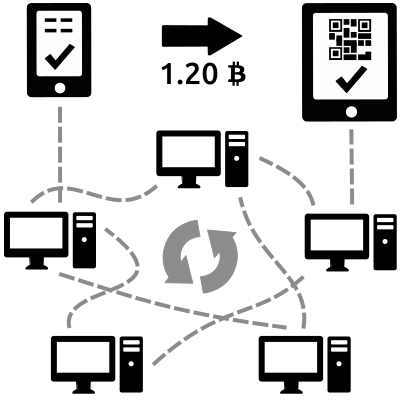
This is a question that often causes confusion. Here's a quick explanation!

The basics for a new user

As a new user, you can get started with Bitcoin without understanding the technical details. Once you have installed a Bitcoin wallet on your computer or mobile phone, it will generate your first Bitcoin address and you can create more whenever you need one. You can disclose your addresses to your friends so that they can pay you or vice versa. In fact, this is pretty similar to how email works, except that Bitcoin addresses should only be used once.

Bitcoin

Balances - block chain

The block chain is a shared public ledger on which the entire Bitcoin network relies. All confirmed transactions are included in the block chain. This way, Bitcoin wallets can calculate their spendable balance and new transactions can be verified to be spending bitcoins that are actually owned by the spender. The integrity and the chronological order of the block chain are enforced with cryptography.

Transactions - private keys

A transaction is a transfer of value between Bitcoin wallets that gets included in the block chain. Bitcoin wallets keep a secret piece of data called a private key or seed, which is used to sign transactions, providing a mathematical proof that they have come from the owner of the wallet. The signature also prevents the transaction from being altered by anybody once it has been issued. All transactions are broadcast between users and usually begin to be confirmed by the network in the following 10 minutes, through a process called mining.

Processing - mining

Image result for bitcoin Processing - mining
Mining is a distributed consensus system that is used to confirm waiting transactions by including them in the block chain. It enforces a chronological order in the block chain, protects the neutrality of the network, and allows different computers to agree on the state of the system. To be confirmed, transactions must be packed in a block that fits very strict cryptographic rules that will be verified by the network. These rules prevent previous blocks from being modified because doing so would invalidate all following blocks. Mining also creates the equivalent of a competitive lottery that prevents any individual from easily adding new blocks consecutively in the block chain. This way, no individuals can control what is included in the block chain or replace parts of the block chain to roll back their own spends.

Going down the rabbit hole

This is only a very short and concise summary of the system. If you want to get into the details, you can read the original paper that describes the system's design, read the developer documentation, and explore the Bitcoin wiki.
Older Posts Home
Subscribe to: Posts ( Atom )

Blog Archive

  • ►  14 ( 6 )
    • ►  08/31 - 09/07 ( 5 )
    • ►  10/19 - 10/26 ( 1 )
  • ►  16 ( 30 )
    • ►  05/29 - 06/05 ( 3 )
    • ►  09/04 - 09/11 ( 8 )
    • ►  09/11 - 09/18 ( 7 )
    • ►  09/18 - 09/25 ( 8 )
    • ►  09/25 - 10/02 ( 2 )
    • ►  10/09 - 10/16 ( 2 )
  • ▼  17 ( 30 )
    • ►  01/22 - 01/29 ( 1 )
    • ►  02/12 - 02/19 ( 11 )
    • ►  02/19 - 02/26 ( 6 )
    • ▼  02/26 - 03/05 ( 12 )
      • Police Can Now Catch Criminals Who Used Bitcoin
      • Heroku: Cloud Application Platform
      • Capital Controls and Ponzi Schemes: How Nigeria Is...
      • What and How does Bitcoin work?
      • Porsche Design introduces the Book One – A plush 2...
      • 800-HP Electric Bugatti Supercar Built, But May Ne...
      • Akyumen's Hawk smartphone packs a projector
      • How to Hack Wi-Fi: Choosing a Wireless Adapter for...
      • Intel Student Ambassador Program for AI: What Is It?
      • Nokia 3310 Dual SIM
      • Nokia 5 is official with beautiful aluminium unibo...
      • HIS HD 6870 IceQ X

Labels

TECH review Computing GADGETS NEWs how to linux Unix Accessories DIY MOBILE OS android ubuntu APPLE IPHONE google Bitcoin IOT Mac OS X USB type-C AI Robot Artificial Intelligence Electric Cars Macs Robot Operating System blog blogger desktop robot wine Electric Vehicle IPHONE 7 Raspberry pi Xcode samsung software platform Business Entertainment GPS IOS IPHONE 7 PLUS Install SimpleScreenRecorder Ubuntu MacOS OS X Plug-in Hybrid ROS camera coupon code godaddy note7 promo codes Adsense Altcoins Chromebook Dell Email Free HP HYBRIDS Raspi-config Sierra Siri Sony browser crime darknet blockchain denmark gnome-tweak-tool ip address
Subscribe to Newsletter
Follow @techtumo
  • Popular Posts
  • Comments
  • Category

Popular Posts

Labels

  • AI Robot
  • APPLE
  • Accessories
  • Artificial Intelligence
  • Business
  • Chromebook
  • DIY
  • Dell
  • Email
  • GADGETS
  • GPS
  • HP
  • IOT
  • IPHONE
  • MOBILE
  • Mac OS X
  • Macs
  • OS
  • ROS
  • Raspberry pi
  • Robot Operating System
  • TECH
  • USB type-C
  • Unix
  • android
  • camera
  • desktop
  • gnome-tweak-tool
  • google
  • how to
  • linux
  • note7
  • review
  • robot
  • samsung
  • software platform

Featured Video

Popular Posts

TECHTUMO@2017. Theme images by MichaelJay. Powered by Blogger.

FACEBOOK FAN PGAE

Category

TECH review Computing GADGETS NEWs how to linux Unix Accessories DIY MOBILE OS android ubuntu APPLE IPHONE google Bitcoin IOT Mac OS X USB type-C AI Robot Artificial Intelligence Electric Cars Macs Robot Operating System blog blogger desktop robot wine Electric Vehicle IPHONE 7 Raspberry pi Xcode samsung software platform Business Entertainment GPS IOS IPHONE 7 PLUS Install SimpleScreenRecorder Ubuntu MacOS OS X Plug-in Hybrid ROS camera coupon code godaddy note7 promo codes Adsense Altcoins Chromebook Dell Email Free HP HYBRIDS Raspi-config Sierra Siri Sony browser crime darknet blockchain denmark gnome-tweak-tool ip address

Translate

  • Home
  • ABOUT US
  • WRITE FOR US
  • CONTACT US
  • Donate
  • Privacy Policy
  • Terms and Conditions

TWITTER PAGE

Tweets by techtumo
© Copyright 2017 TECH TUMO . Blogger Templates Designed by Bloggertheme9 . Powered by Blogger .